Published by:
CGP EDU Academic Team
Published on: September 12, 2026
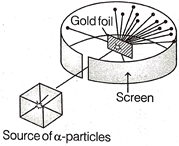
In Geiger-Marsden experiment detection of  -particles scattered at a particular angle is done by
A
counting flashes produced by  -particles on a ZnS coated screen
-particles on a ZnS coated screen B
counting spots produced on a photographic film
C
using a galvanometer detector
D
using a Geiger-counter
Text Solution
Verified by ExpertsThe correct answer is:
A
The scattered  -particles were observed through a rotatable detector consisting of zinc sulphide screen and a microscope. The scattered
  -particles on striking the screen produced brief light flashes or scintillations. These flashes may be viewed through a microscope and the distribution of the number of scattered particles may be studied as a function of angle of scattering.
Prepare Smarter with CGP Edu
Get practice questions, solutions, and test series in one place.
Write a Review
Share your experience with this question and solution.
Commentary
Send your comment, doubt, correction, or feedback to admin.
Similar Questions
Explore conceptually related problems
Order of magnitude of density of uranium nucleus is ( )
Radius of nucleus is 4 fm. The radius of nucleus will be
If an electron and a positron annihilate, then the energy released is
If and are the masses of nucleus, neutron and proton respectively, then
The masses of neutron and proton are 1.0087 amu and 1.0073 amu, respectively. If the neutrons and p…
Assume that protons and neutrons have equal masses. Given that nuclear radius is given by metre an…